I Drove a Toyota Mirai for a Week
commentary
A week with Toyota’s hydrogen sedan — Hydrogen’s Problem Isn’t the Car.
by Patrick Hong

After spending a week with a Toyota Mirai, I understand both why hydrogen cars are so compelling—and why, after more than two decades, they still haven’t broken through.
The Mirai may be one of the strangest new-car propositions in America.
A 2026 Mirai starts around $52,000, yet Toyota is currently offering qualified buyers 0% annual percentage rate (APR) financing for 72 months plus a $35,000 incentive. Toyota also provides purchasers up to $15,000 of complimentary hydrogen (Toyota current Mirai offer).
That got me doing the numbers.
Using roughly $53,000 as the purchase price, the incentive brings the effective financed amount to about $18,000. At 0% APR for 72 months, that's $250/month.
I compared that with a similarly sized $28,000 gasoline hybrid, financed at 5% APR for 72 months, driven 12,000 miles annually and returning 50 miles per gallon (MPG).
Using a two-year ownership horizon, $4.50 gasoline, an estimated $18,200 resale value for the hybrid, and a pessimistic $6,000 resale value for the Mirai, my simplified calculation comes to roughly:
Mirai: $12,000 net two-year cost
Gas hybrid: $14,364 net two-year cost
So even with brutal depreciation, the Mirai can actually be about $2,400 cheaper over two years under these assumptions. That excludes taxes, insurance, registration and maintenance for both vehicles.
Then I actually lived with one.
The Mirai is remarkably quiet, smooth and responsive. It essentially drives like an electric vehicle (EV) because a fuel-cell vehicle is electrically driven—the hydrogen fuel cell generates electricity onboard.
Packaging is less impressive. The back seat is tight. Two adults barely fit comfortably, and I would consider the middle position more appropriate for a child.
Then there is fueling.
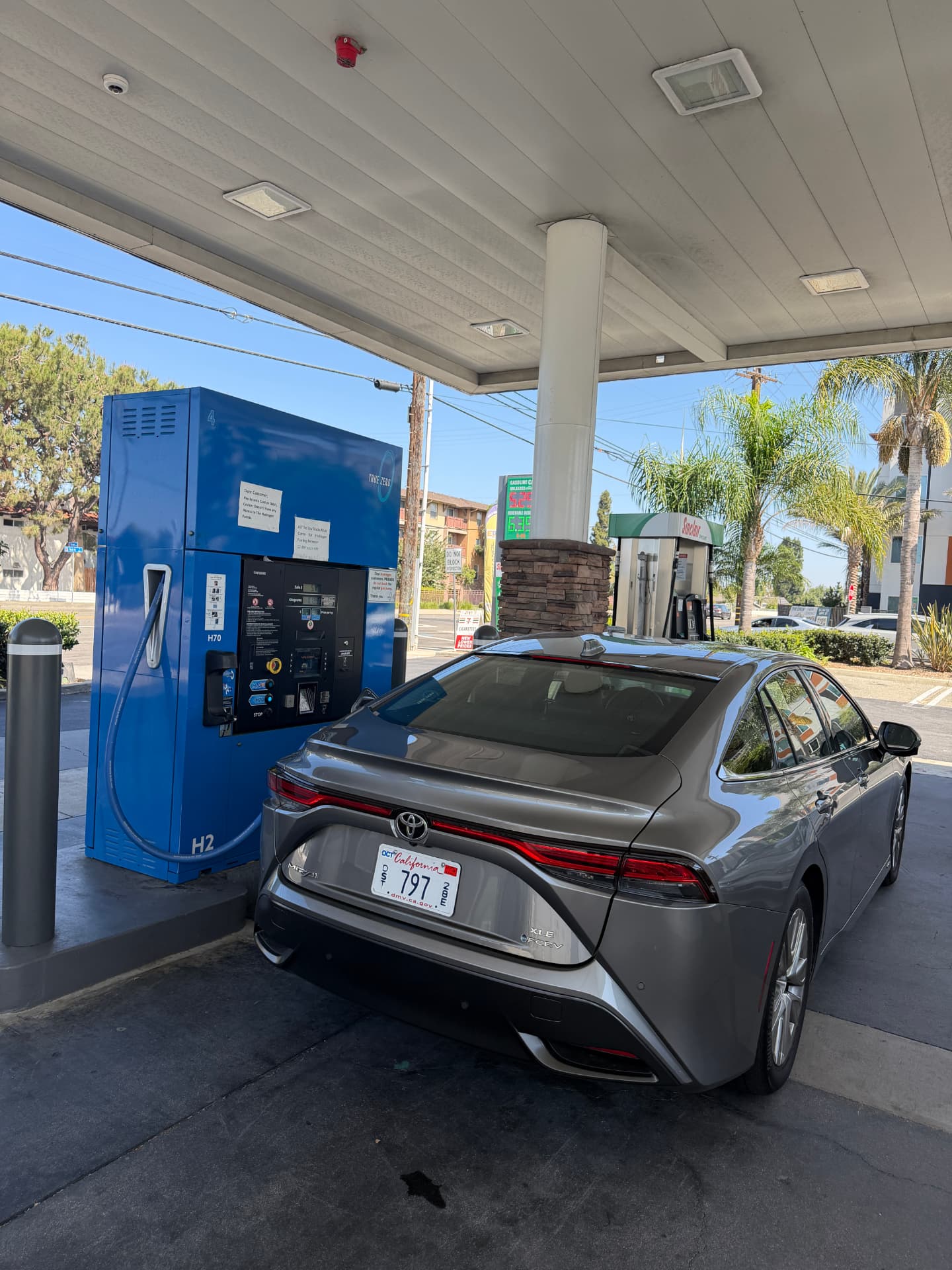
I was fortunate to have a few hydrogen stations about 20 minutes away. Once you find one, fueling is remarkably easy, much closer to filling a gasoline car than charging an EV. Toyota describes the process as essentially attaching a nozzle and filling its high-pressure tanks.
But my fill stopped at around 75%. Hydrogen refueling is more complicated than pumping gasoline: tank pressure, temperature, station precooling and fueling protocols all affect how hydrogen is transferred safely.
And hydrogen isn't cheap.
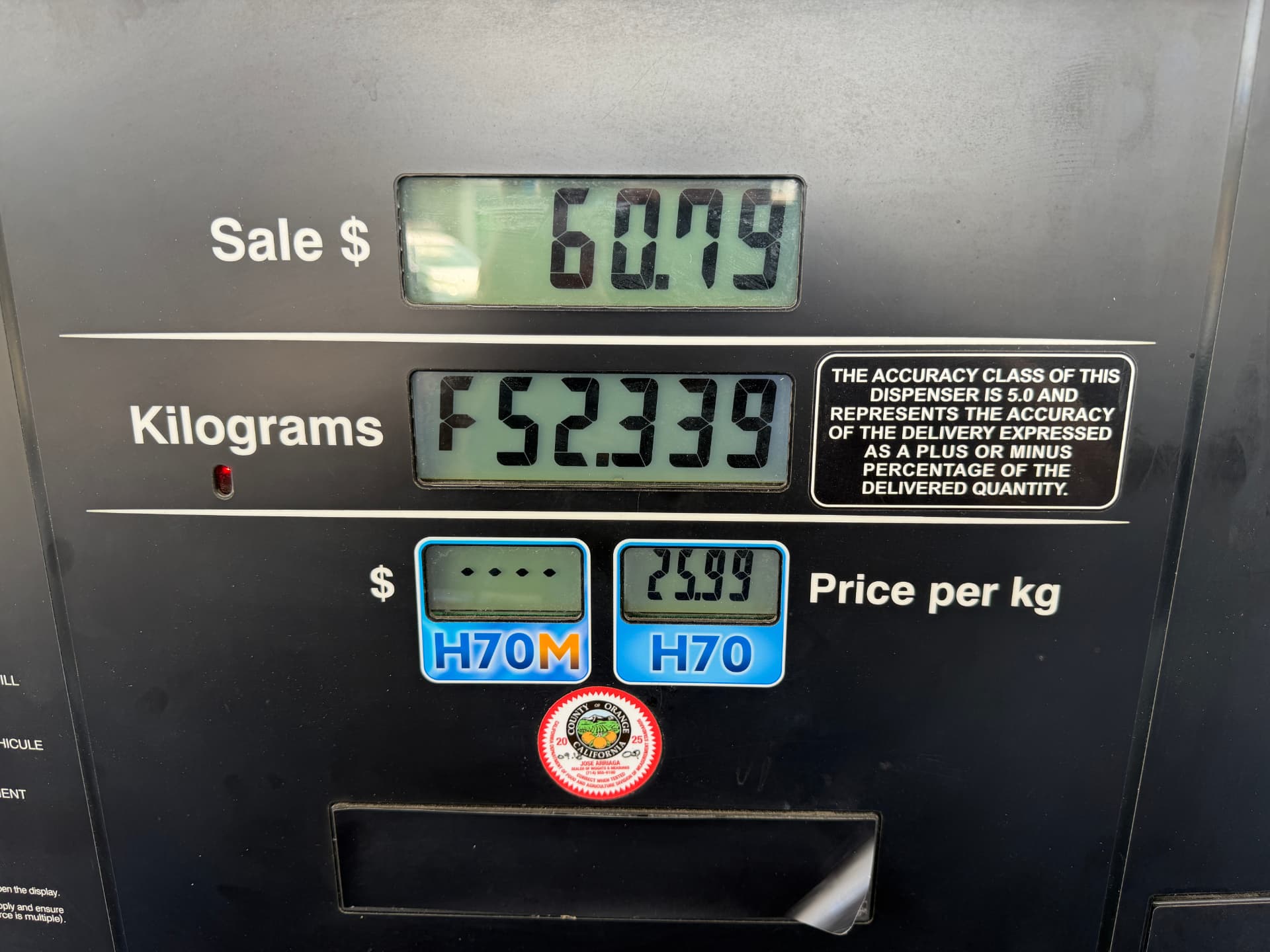
I paid $25.99/kg. The U.S. Department of Energy (DOE) defines approximately 1 kg of hydrogen as one gasoline gallon equivalent (GGE) in energy content (DOE Alternative Fuels Data Center). So $25.99/kg is roughly $25.99 per gasoline gallon equivalent. That's an energy comparison, not a direct MPG comparison. The Mirai holds about 5.6 kg, meaning a completely empty-to-full fill at that price would cost about $146 (Toyota Mirai technical background).
My roughly 75% fill (I added about 2.4 kg for aoubt $60) would represent about 4.2 kg, or $109, and I saw approximately 300 miles of real-world Southern California range. That's around 36 cents per mile in hydrogen. My hypothetical 50-MPG hybrid at $4.50 gasoline costs only about 9 cents per mile.
Without Toyota's $15,000 fuel card, that changes the economics dramatically.
There was one feature I loved on the Mirai: the H₂O button.
Water is the fuel cell's byproduct, and the Mirai normally discharges it automatically. But Toyota also gives the driver a manual water-release switch so you can purge it before parking somewhere you don't want a puddle. In other words, you can tell your highly sophisticated hydrogen car to go pee before coming into the garage.
Oddly, that gives an otherwise appliance-like high-tech vehicle a little personality.
But my week with the Mirai raised a bigger question: Is hydrogen simply where EVs were 20 years ago?
The modern EV story arguably begins with General Motors' (GM) EV1 in 1996. Then came Tesla, the Roadster, the Leaf and Bolt, the Model S, and eventually the Model 3 around 2017—roughly 21 years after the EV1 (U.S. DOE history of the electric car).
Hydrogen has had a surprisingly similar runway.
Honda put an FCX into the hands of an individual customer in 2005, followed by the FCX Clarity in 2008 (Honda FCX history). Mercedes offered the B-Class F-CELL to California consumers in 2010 (Mercedes-Benz F-CELL). Hyundai followed with the Tucson Fuel Cell in 2014 and NEXO in 2018 (Hyundai Tucson Fuel Cell; Hyundai NEXO).
Toyota launched the Mirai in 2015, and it became the most visible symbol of the hydrogen passenger-car experiment.
Yet the adoption curves diverged.
U.S. fuel-cell electric vehicle (FCEV) sales peaked at only 3,341 in 2021 and fell to 611 in 2024, with cumulative U.S. FCEV sales reaching only 18,568 through 2024 (Hydrogen Fuel Cell sales data).
The Mirai itself peaked at 2,737 U.S. sales in 2023, then dropped to 499 in 2024 and 210 in 2025. Through July 2026, sales have rebounded almost 95% year over year—but that represents only 152 cars (Mirai sales history).
EVs faced many of the same early problems: high vehicle costs, range anxiety, limited choice and inadequate infrastructure.
The critical difference is that EV infrastructure eventually began reinforcing vehicle adoption. Tesla didn't just build cars; in 2012 it began building its own Supercharger network, starting with six stations (Tesla Supercharger launch). And EVs had another enormous advantage: electricity was already everywhere. Many owners could charge at home.
Hydrogen requires hydrogen production, transportation, storage, and an entirely new network of high-pressure fueling stations to scale alongside the cars.
That's why my week in the Mirai left me thinking the car itself isn't really the problem anymore.
It's quiet. It's refined. It has useful range. Refueling can take minutes. And with Toyota subsidizing both the purchase and the fuel, it can even make financial sense—for the right owner in the right part of California.
But perhaps that's also the warning sign.
More than 20 years after hydrogen cars first reached individual consumers, Toyota still needs a $35,000 incentive and $15,000 of complimentary hydrogen to make the economics compelling.
EVs eventually found their Tesla moment.
The Mirai makes me wonder whether hydrogen is still waiting for its own, or if it will ever happen.
Comments
Loading comments…