2026 Nissan Rogue SV AWD
Consensus at a glance
- Consensus score
- Not yet rated
- Price
- $30,920 – $42,550
- Powertrain
- Gasoline
- Combined fuel economy
- 32 MPG
- Body type
- suv
.jpg)
.jpg)
.jpg)
%20USE.jpg)
.jpg)
nissan rogue sv awd
1. Quick Take
The 2026 Nissan Rogue SV AWD positions itself as the "goldilocks" choice of the compact SUV market, balancing cost, comfort, and feature availability. Reviewers characterize it as a sensible "appliance" designed to master the suburban grind rather than conquer off-road trails. The SV trim is the volume-selling sweet spot, offering attainable luxury with power seats and advanced tech. Under the hood lies a unique 1.5-liter Variable Compression Turbo (VC-Turbo) three-cylinder engine that shapeshifts internally to prioritize power or efficiency. While driving dynamics are described as safe rather than sporty, the cabin is praised for Nissan's "Zero Gravity" seats which offer class-leading comfort. Ideally suited for the pragmatic buyer, the Rogue delivers a user-friendly, premium-feeling experience for those willing to accept the complexity of its unique powertrain.
2. Its Main Competition
The Rogue SV AWD competes in the industry’s most cutthroat segment, facing established juggernauts like the Toyota RAV4 and Honda CR-V. While the RAV4 attracts reliability-focused buyers and the CR-V wins on space and resale value, the Rogue carves a niche as the "premium mainstream" middle ground. It offers a nicer interior ambiance than the Toyota and more conventional styling than the polarizing Hyundai Tucson. The Mazda CX-5 remains the clear "driver’s choice" with superior handling, whereas the Subaru Forester dominates the rugged, all-weather sub-sector. Ultimately, the Rogue distinguishes itself through a quieter, more upscale cabin presentation that aims to feel more expensive than its utilitarian rivals, effectively targeting buyers who want a touch of luxury without the premium price tag.
3. Its Buyer’s Demographics
Research depicts the Rogue SV buyer as the pragmatic middle of the market, typically aged 30 to 60 with household incomes between $60,000 and $120,000. This demographic creates a barbell shape: young families seeking a "do-it-all" shuttle for school runs and empty-nesters drawn to the vehicle’s easy ingress and visibility. Psychographically, these shoppers are value-conscious and payment-sensitive rather than performance-oriented, often prioritizing safety features over horsepower. Data suggests a skew toward female buyers who cross-shop the CR-V and RAV4 but land on the Rogue due to aggressive financing incentives. Ultimately, these buyers view the vehicle through the lens of monthly costs, choosing the Rogue because it offers more creature comforts for the same expenditure as its competitors.
4. Design
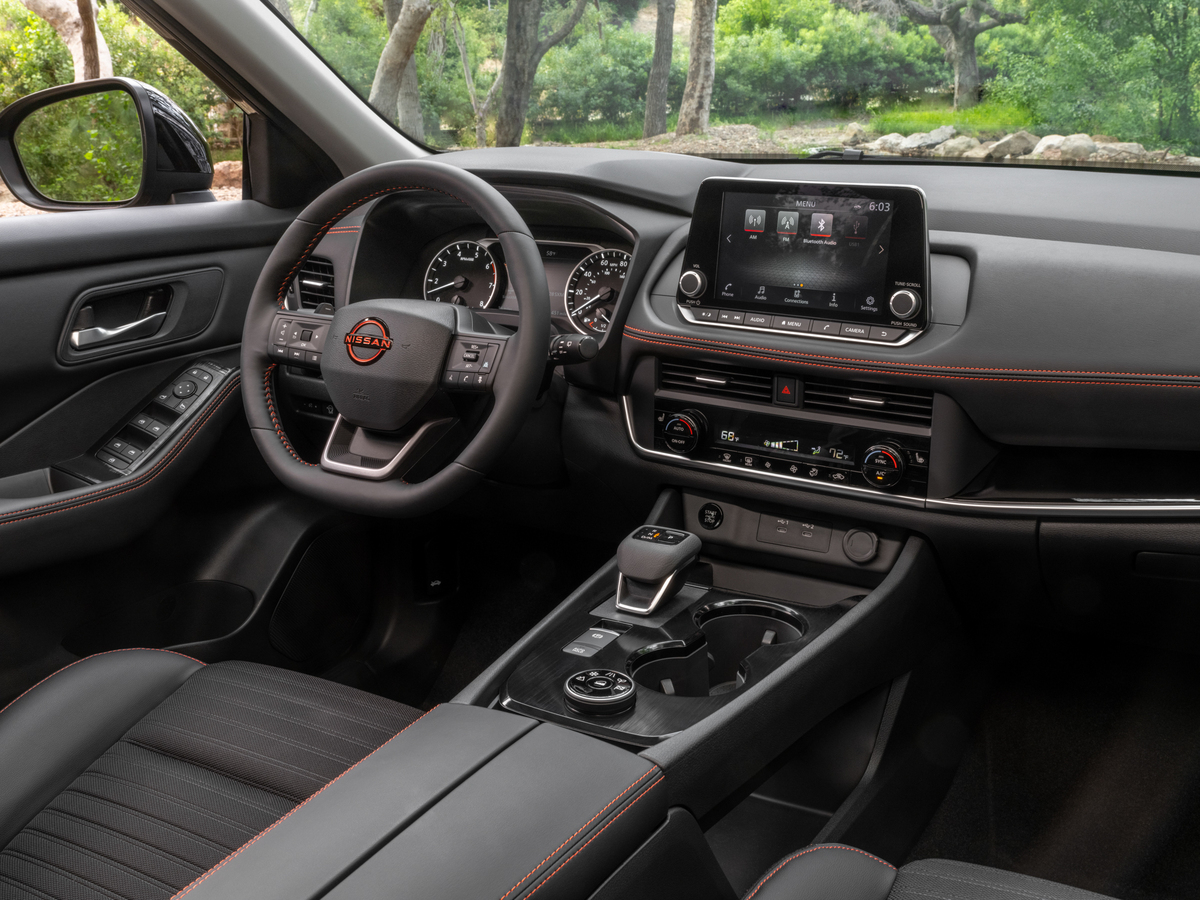
The 2026 Rogue strikes a visual balance described as "assertive but safe," utilizing a boxy, upright stance that conveys utility without being overly rugged. The front end features Nissan’s V-motion grille and a split-headlight design that looks current and technical. However, the true design victory lies inside the cabin, where the Rogue punches above its weight class. The interior features a horizontal dashboard layout and soft-touch materials that feel richer than the hard plastics found in equivalent competitors. A "floating" center console adds a modern architectural touch while creating extra storage space. Although some critics note the scratch-prone gloss black trim, the overall execution is cohesive and airy, successfully making owners feel they spent more money than the sticker price suggests.
5. Interior & Cargo Room
While the Rogue SV AWD is not the undisputed king of volume—trailing the cavernous Honda CR-V—it is praised for exceptional usability. Front and rear headroom are ample, though rear legroom is merely average for the class. A standout feature is the rear doors, which open to nearly 90 degrees, drastically simplifying the process of loading car seats or bulky items. Cargo space remains competitive, offering roughly 36.5 cubic feet behind the second row and expanding to 74 cubic feet with seats folded. The available "Divide-N-Hide" cargo system earns high marks for its flexible shelving configurations that secure groceries and valuables. Despite a high load floor, the Rogue is viewed as a masterclass in practical packaging for families.
6. Ergonomics & Comfort
If there is one area where the Rogue consistently outperforms rivals, it is seat comfort. Nissan’s "Zero Gravity" seats provide superior support that minimizes fatigue on long drives, often outclassing the firmer benches in the RAV4. Ergonomically, the cabin retains a sensible "tactile logic," utilizing physical knobs for climate and volume rather than burying them in touchscreens. The center console features a "butterfly" opening lid for easy access and a lower storage bridge for personal items. While thick rear pillars create standard SUV blind spots, outward visibility is generally good, and the driving position is commanding. Overall, the Rogue is characterized as an incredibly easy car to live with, requiring almost no learning curve to operate comfortably.
7. Interior, Fit & Finish
The aggregated verdict on the Rogue’s interior is that it feels "near-premium," offering an ambiance that rivals the class buzzwords for quality. Assembly is tight, with consistent panel gaps and switchgear that feels substantial rather than hollow. Soft materials cover the primary touchpoints, such as the dashboard and armrests, creating an inviting atmosphere that helps justify the price. However, cost-cutting is evident in the harder plastics used on lower door panels and the scratch-prone piano black trim around the shifter. Despite these minor discrepancies, the consensus is that the Rogue SV offers a higher-quality interior presentation than the median competitor, providing a refined environment that feels a distinct step up from previous generations.
8. Driver & Pass UX
The User Experience (UX) in the Rogue SV is defined by a successful marriage of digital and analog elements. The infotainment interface is described as logical and easy to navigate, with a tile-based structure that supports Apple CarPlay and Android Auto reliably. While the screen isn't the fastest on the market, the presence of hard buttons for shortcuts and climate control significantly boosts usability. Digital instrument clusters provide essential information clearly without overwhelming graphics. Voice control is functional but bested by smartphone assistants, though Google Built-in is a highlight on higher packages. Ultimately, the tech suite feels helpful rather than intrusive, designed for pragmatism and minimizing driver distraction through a "low friction" interface.
9. Sound System
The audio experience in the standard Rogue SV AWD is best described as "functional" but uninspired. The base six-speaker system is tuned primarily for clarity in the vocal range, making it perfectly adequate for podcasts and news radio during the daily commute. However, music lovers will find it lacks the dynamic range and bass extension required for an immersive experience, often sounding thin at higher volumes. The optional Bose premium audio offers a significant improvement with better soundstaging, but the base system benefits from the Rogue's quiet cabin, which reduces the need for high volume. It is a system that gets the job done for the average user but will essentially force audiophiles to seek an upgrade.
10. Acceleration
The powertrain is the Rogue’s most technologically interesting yet controversial feature. The 1.5-liter three-cylinder VC-Turbo engine produces 201 horsepower, delivering snappy low-end torque that makes the vehicle feel eager around town. However, while 0-30 mph performance is spirited, the 0-60 mph time lands in the average eight-second range. The Continuously Variable Transmission (CVT) still exhibits a "rubber band" sensation, where engine revs disconnect from acceleration speed. Under hard throttle, the three-cylinder engine emits a coarse, off-beat growl that disrupts the cabin's refinement. While perfectly adequate for suburban driving, the powertrain lacks the linear feel of traditional automatics and loses composure when passing at highway speeds.
11. Braking
Braking performance in the Rogue SV AWD is characterized as safe and competent, though not class-leading. In emergency stopping tests from 60 mph, the Rogue typically halts in the mid-120-foot range, landing squarely in the middle of the pack. The brake pedal feel is tuned for comfort, described by reviewers as "soft" or having initial squish, which facilitates smooth modulation in stop-and-go traffic. However, this lack of immediate bite can feel vague to drivers accustomed to sportier vehicles. The system is stable and devoid of drama, stopping straight and true even during panic maneuvers. It is a braking setup perfectly matched to the vehicle’s relaxed, family-hauling demeanor rather than spirited driving.
12. Handling
On the road, the Rogue prioritizes stability and ease of use above all else. Steering effort is notably light, making parking maneuvers and U-turns effortless in urban environments. On the highway, the vehicle tracks straight with minimal correction, offering a low-stress experience. However, "low stress" also means low engagement; the steering offers almost no feedback, feeling video-game-like. When pushed into corners, the Rogue exhibits noticeable body roll, signaling the driver to dial back the aggression. While it handles competently and predictably with smooth stability control intervention, it offers zero entertainment value. It is essentially a tool for transport, erasing the road rather than connecting the driver to it.
13. Interior Noise
The Rogue SV AWD presents a duality in its acoustic performance. At a steady highway cruise, it is one of the quietest vehicles in its class, thanks to extensive sound insulation and acoustic glass that suppress wind and tire noise effectively. Active Noise Cancellation further neutralizes low-frequency booming. However, this serenity is disrupted by the engine; under heavy acceleration, the three-cylinder turbo produces a coarse, gravelly growl that cuts through the sound deadening. The CVT exacerbates this by holding high RPMs during merging or climbing. The result is a vehicle that feels wonderfully premium and refined 90% of the time, but notably unrefined when the powertrain is strained.
14. Ride Quality
Ride comfort is the Rogue’s dynamic ace in the hole. The suspension is tuned unapologetically for compliance, absorbing highway expansion joints and potholes with a cushioned, "lofty" feel that isolates passengers from the road. In the city, it rounds off the sharp edges of broken pavement, avoiding the harsh "crash" sensation found in sportier competitors like the Mazda CX-5. While the soft tuning can result in slight body float over large dips, it makes the Rogue an excellent long-distance freeway cruiser. For the target demographic of families and commuters, this prioritization of spine health over cornering speed is widely viewed as a major strength.
15. Driver Assist Systems
For the money, the Rogue SV AWD offers one of the best assisted-driving experiences on the market. The standout feature is ProPILOT Assist, which combines smooth adaptive cruise control with confident steering assist to keep the car centered in its lane. Reviewers consistently rank it superior to base systems in rivals, noting its natural tracing of highway curves. The standard Safety Shield 360 suite adds detailed protection, with the rear automatic braking feature widely praised for preventing parking lot fender benders. While some alerts can be sensitive, the systems are intuitive to operate via dedicated steering wheel buttons, making the Rogue a sophisticated and helpful road-trip companion.
16. Mileage
The Rogue achieves impressive fuel economy figures for a non-hybrid all-wheel-drive SUV, with EPA ratings around 31 mpg combined. The variable-compression engine technology allows it to lead the pack among gas-only competitors. However, when compared to the hybrid variants of the RAV4 and CR-V—which approach 40 mpg—the Rogue falls behind significantly. Furthermore, real-world reports suggest the small turbo engine is sensitive to driving style; aggressive inputs or city stop-and-go traffic can drop mileage into the mid-20s. For buyers unwilling to pay for a hybrid, the Rogue is efficient, but it cannot match the total range and carbon footprint of its electrified rivals.
17. Safety
Safety is a pillar of the Rogue’s value proposition. The vehicle consistently earns high marks, securing a 5-Star Overall Rating from the NHTSA and Top Safety Pick accolades from the IIHS. Beyond robust crash structure, the Rogue is praised for democratizing safety tech; essential features like blind-spot monitoring and rear cross-traffic alert are standard on the SV trim rather than optional. The automatic braking systems perform reliably in pedestrian detection tests. While no car is invulnerable, the Rogue remains a "mainstream-safe" choice that sits comfortably at the top table of family protection, offering both the active technology to avoid accidents and the passive structure to survive them.
18. Pricing
The 2026 Rogue SV AWD generally carries an MSRP in the mid-$30,000 range, placing it competitively against the Honda CR-V EX and Toyota RAV4 XLE. However, the "paper price" tells only half the story. Nissan is historically more aggressive with incentives, lease deals, and financing offers than its main rivals, meaning the actual transaction price is often significantly lower. Buyers can frequently acquire a well-equipped SV for the same monthly payment as a lower-trim competitor. This strong "feature-per-dollar" ratio drives sales, though adding packages can push the price dangerously close to $40,000, where the value equation becomes less compelling against premium brands.
19. Value
The Rogue presents a "Lease vs. Buy" paradox. At the time of purchase, it offers incredible value, delivering more equipment—such as 360-degree cameras and ProPILOT Assist—for the dollar than market leaders. If prioritizing monthly payments and immediate creature comforts, the Rogue SV is a compelling bargain. However, the long-term value equation is weaker due to higher depreciation rates compared to Toyota or Honda. It is a poorer candidate for short-term owners who trade in frequently, but an excellent value for lessees or "buy and hold" owners who plan to drive the vehicle until the wheels fall off.
20. Reliability
Views on the 2026 Rogue’s reliability are cautiously optimistic but mixed. While the transmission failures of the past are largely resolved, the complexity of the new VC-Turbo engine combined with the CVT still gives some buyers pause. Aggregated data places the Rogue in the "average" reliability tier; it is not a ticking time bomb, but neither is it the "bulletproof" gold standard of a naturally aspirated RAV4. Electrical glitches and infotainment freezes are occasional complaints. Ideally, the Rogue serves as a dependable companion during the warranty period, though risk-averse buyers are often advised to consider extended coverage to hedge against the potential long-term maintenance of its complex powertrain.
Frequently asked questions about the 2026 Nissan Rogue SV AWD
Is the 2026 Nissan Rogue SV AWD worth buying?
The 2026 Nissan Rogue SV AWD positions itself as the "goldilocks" choice of the compact SUV market, balancing cost, comfort, and feature availability. Reviewers characterize it as a sensible "appliance" designed to master the suburban grind rather than conquer off-road trails. The SV trim is the volume-selling sweet spot, offering attainable luxury with power seats and advanced tech. Under the hood lies a unique 1.5-liter Variable Compression Turbo (VC-Turbo) three-cylinder engine that shapeshifts internally to prioritize power or efficiency. While driving dynamics are described as safe rather
How much does the 2026 Nissan Rogue SV AWD cost?
The 2026 Nissan Rogue SV AWD is priced at $30,920 – $42,550 , before destination, options, and incentives.
What is the fuel economy of the 2026 Nissan Rogue SV AWD?
The 2026 Nissan Rogue SV AWD returns 32 MPG combined per published EPA figures.
How this review is produced
moblr meta-reviews are generated by aggregating multiple published expert road tests using AI consensus and sentiment analysis, then read and reviewed by a human editor before publication. Category ratings on the −50 to +50 scale show how each vehicle compares to the average for its segment. Learn more about the moblr review process.