click to:

this car's raw scores
(no group averaging)
extra
info
2027 Nissan Rogue Hybrid SV
overall raw score:
6.9
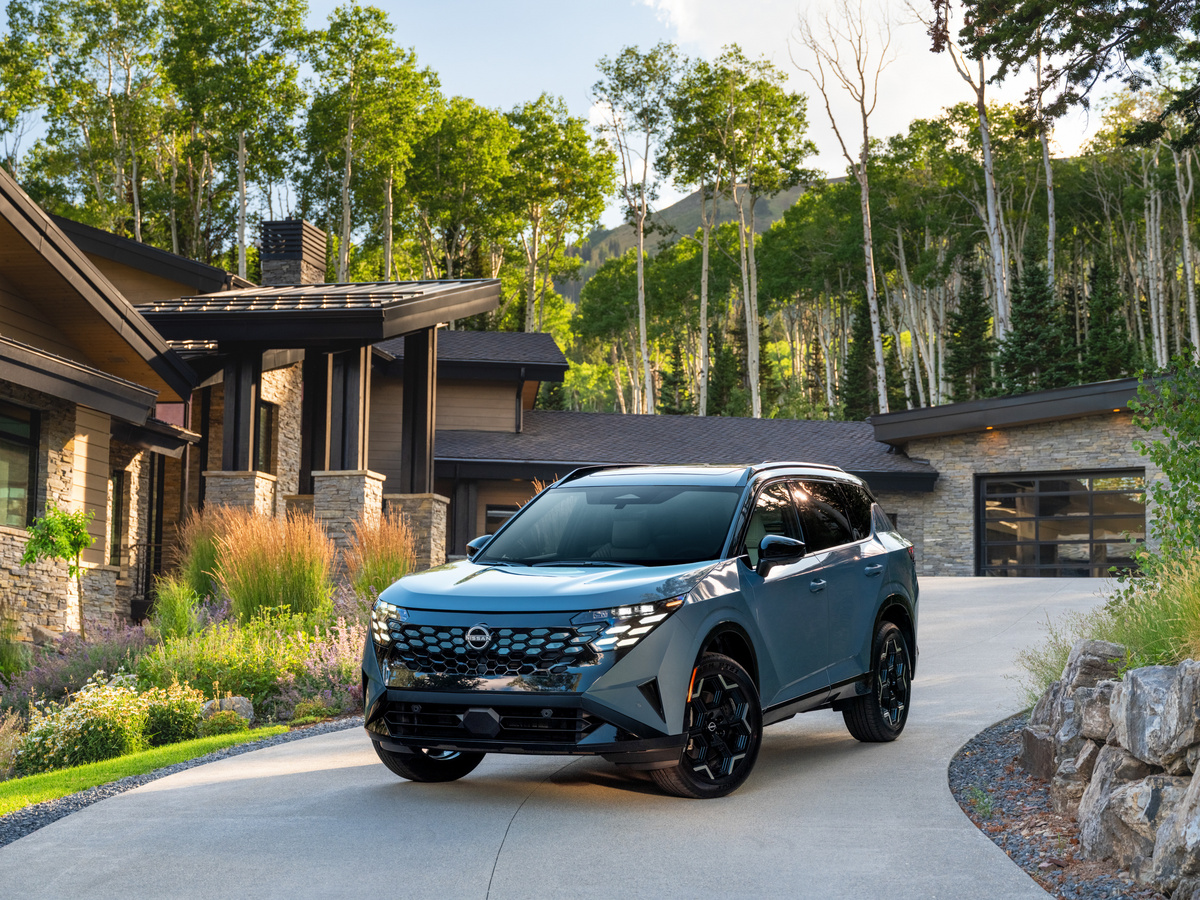
Front three-quarter
1. Quick Take
1. Quick Take The 2027 Nissan Rogue Hybrid SV is a five-passenger compact crossover powered by Nissan’s e-POWER series-hybrid system. A 1.5-liter turbocharged three-cylinder gasoline engine functions solely as an onboard generator, feeding electric motors that provide dual-motor all-wheel drive and a combined 225 horsepower without a conventional transmission. This layout delivers instant electric-motor torque and low-speed smoothness without requiring plug-in charging. The SV trim starts at $35,490 plus a $1,575 destination charge and comes equipped with dual 12.3-inch displays, wireless Apple CarPlay and Android Auto, a 15-watt Qi2 magnetic wireless charger, heated front seats, and ProPILOT Assist. An optional $2,100 SV Premium Package adds quilted TailorFit leatherette, a panoramic moonroof, and gloss-black roof rails. Rated at 41 mpg city, 35 mpg highway, and 37 mpg combined, it accelerates from zero to 60 mph in roughly 6.2 to 6.4 seconds and tows up to 1,500 pounds.
2. Its Main Competition
The Rogue Hybrid SV competes directly against compact hybrid crossovers such as the Toyota RAV4 Hybrid, Honda CR-V Hybrid, Hyundai Tucson Hybrid, and Ford Escape Hybrid. Its defining distinction is the e-POWER series-hybrid architecture, where electric motors drive the wheels exclusively and the gasoline engine never mechanically connects to the driveline. Rivals instead use parallel or power-split hybrid systems that route both engine and motor torque through transmissions. This gives the Rogue EV-like low-speed response, shift-free acceleration, and one-pedal driving capability via e-Pedal. Inside, the SV trim includes dual 12.3-inch screens and a 15-watt Qi2 magnetic wireless charger as standard equipment, items frequently reserved for pricier upper trims on competing models. However, its 37 mpg combined rating and 1,500-pound towing capacity sit mid-pack against certain competitors, and its 36.2 inches of rear legroom trail the CR-V and Tucson.
3. Its Buyer's Demographics
Buyers of the Rogue Hybrid SV are typically pragmatic, tech-focused individuals and families seeking fuel savings, safety features, and daily comfort. Most fall between their late 20s and mid-50s, earn middle to upper-middle household incomes, and hold college degrees. Many are married professionals with one or two children who need a versatile vehicle for commuting and errands. Shoppers appreciate the electric-like driving feel without having to manage home charging or range planning. Family-friendly features like rear doors opening nearly 90 degrees and five LATCH anchors strongly appeal to parents installing child seats. The SV trim specifically targets value-conscious shoppers who want substantive standard equipment, including ProPILOT Assist, heated front seats, and a power liftgate, without paying for flagship luxury trims. Many cross-shop mainstream Japanese rivals or transition from earlier gasoline Rogue models to lower their routine fuel expenses.
4. Design
The exterior design of the 2027 Rogue Hybrid SV presents modern, athletic proportions with chiseled lines, slim LED headlights featuring auto high-beam assist, and standard 18-inch dark-painted alloy wheels. It avoids overly aggressive angles, instead aiming for a refined, contemporary crossover appearance. Inside, the cabin layout centers on standard dual 12.3-inch displays for the digital instrument cluster and infotainment touchscreen. Rather than routing all operations into digital submenus, the dashboard retains physical toggle switches and buttons for the climate controls. The center console adopts a push-button gear selector that replaces the former shifter, creating room for an enlarged storage pass-through underneath. Durable cloth upholstery and heated front seats come standard, while the optional SV Premium Package introduces quilted TailorFit leatherette, gloss-black roof rails, and a panoramic moonroof that brings additional natural light into the passenger space.
5. Interior & cargo room
The interior emphasizes practical daily utility, seating up to five occupants on standard Zero Gravity front seats designed to reduce fatigue on long trips. The driver receives an eight-way power-adjustable seat, while the front passenger seat features four-way manual adjustment. Rear passengers benefit from 60/40 split-folding seats that recline, though rear legroom measures 36.2 inches, which feels tighter than in roomier alternatives like the Honda CR-V Hybrid. Rear doors open nearly 90 degrees, simplifying adult ingress and child safety seat installation across the five LATCH anchors. Cargo capacity measures 31.1 cubic feet behind the second row and expands to 65.9 cubic feet with the rear seats folded down. A standard power liftgate, low liftover height, and flat cargo floor facilitate loading luggage and strollers, supplemented by an enlarged under-console storage area inside the front cabin.
6. Ergonomics & Comfort
The driving position provides an upright viewpoint with clear sightlines over a low dashboard. Ergonomics benefit from physical dual-zone climate toggle switches and audio knobs, allowing adjustments without navigating touchscreen menus. A push-button gear selector replaces traditional levers, creating an enlarged under-console storage tray. Front Zero Gravity seats provide supportive cushioning that minimizes physical fatigue during extended commutes, assisted by standard heated front cushions and a heated steering wheel. The passenger seat relies on four-way manual adjustment. Rear seats recline for passenger comfort, though taller adults encounter firmer seat bottoms and tighter legroom than in certain segment alternatives. Device charging is well-managed through multiple USB-C ports and a dedicated 15-watt Qi2 magnetic wireless charging pad. Rear doors opening nearly 90 degrees and five LATCH anchors provide convenient access for child seat placement.
7. Interior, fit & finish
The cabin features a modern layout anchored by standard dual 12.3-inch displays integrated into the dashboard with crisp graphics. Material selection blends soft-touch surfaces across upper touchpoints with durable hard plastics along lower door panels and console sections. Standard cloth upholstery is built for daily wear, while the optional SV Premium Package upgrades the cabin with quilted TailorFit leatherette seating and a panoramic moonroof. Physical controls, including traditional turn-signal stalks and climate toggles, deliver tactile feedback that avoids total touchscreen reliance. The push-button gear selector cleans up the center console design, though it requires brief familiarization during multi-point parking maneuvers. Tight panel tolerances and rigid construction keep squeaks and rattles controlled, which is particularly noticeable because the electric-drive powertrain operates without the intrusive mechanical vibrations and constant drone of a traditional internal combustion driveline.
8. Driver & Pass UX
The user experience centers on dual 12.3-inch screens for instrumentation and infotainment, providing clear graphics and legible readouts. Physical toggle switches and rotary dials for climate controls ensure core adjustments remain intuitive while driving. Standard wireless Apple CarPlay and Android Auto handle navigation, streaming, and messaging seamlessly, while Bluetooth devices pair without difficulty. A 15-watt Qi2 magnetic wireless charger secures and charges smartphones on the center console. The digital cluster clearly displays driver assistance telemetry from the upgraded ProPILOT Assist system, while Lead Car Departure Notification alerts drivers when stopped traffic resumes moving. The SV trim includes remote engine start via the key fob. However, it lacks Google built-in voice assistance and NissanConnect subscription services, such as an in-vehicle Wi-Fi hotspot, over-the-air updates, and smartphone-app remote features, which are reserved for higher trim levels.
9. Sound System
The Rogue Hybrid SV comes standard with a factory six-speaker audio setup designed for everyday media consumption. The speakers are tuned for vocal clarity, reproducing dialogue with crisp articulation that benefits spoken-word formats such as podcasts, news, and phone calls. For music playback, the system provides balanced mid-range tones and clear treble, though low-end bass extension lacks deep resonance at elevated volumes. The listening environment benefits significantly from the e-POWER series-hybrid architecture; because the gasoline engine functions solely as an electrical generator and runs at steady speeds, mechanical drivetrain noise and gear drone are largely absent. With fewer powertrain vibrations invading the cabin, audio output remains intelligible at lower volume levels. Wireless Apple CarPlay and Android Auto integration allow seamless streaming from preferred music applications. The setup delivers straightforward, competent sound without specialized multi-speaker branding.
10. Acceleration
Propulsion is handled entirely by electric motors: a 202-horsepower front motor with 243 pound-feet of torque and a 134-horsepower rear motor producing 144 pound-feet of torque, combining for 225 horsepower. The 1.5-liter turbocharged three-cylinder engine never connects to the drive wheels, acting solely as an electrical generator for the 1.67 kWh lithium-ion battery and motors. Because there is no transmission, pressing the accelerator yields immediate, linear torque delivery without gear hunting or downshift delay. This configuration achieves zero-to-60 mph acceleration in 6.2 to 6.4 seconds, providing brisk highway merging and responsive urban passing power. Drivers can engage e-Pedal for one-pedal driving, while Smooth Stop technology refines deceleration. Under sustained high-speed uphill climbs or continuous heavy throttle, the gasoline generator runs at higher, steady revolutions to supply sufficient electricity, creating engine noise that sounds detached from vehicle road speed.
11. Braking
Braking performance combines regenerative deceleration from the electric drive motors with four-wheel disc brakes. Emergency stops from 60 mph occur in approximately 119 to 125 feet, with the chassis remaining stable and tracking straight under heavy pedal pressure. Everyday braking benefits from Smooth Stop software tuning, which actively regulates hydraulic pressure in the final feet of deceleration to eliminate nose dive and abrupt passenger head movement. The standard e-Pedal function provides true one-pedal driving, enabling drivers to slow down and reach a complete halt simply by easing off the accelerator. In normal traffic, the transition between motor regeneration and friction braking feels smooth and progressive under light to moderate pedal application. However, quick transitions between lifting off the throttle and aggressively pressing the brake pedal can occasionally produce a slightly grabby response as friction pads engage.
12. Handling
On highways, the Rogue Hybrid SV tracks straight with a planted, secure feel that demands minimal steering corrections. Its electric power steering is calibrated with light-to-moderate effort and delivers linear, predictable responses to driver inputs, prioritizing relaxed cruising over sharp road feedback. The standard dual-motor all-wheel-drive system distributes electric torque between the front and rear axles, aiding traction when accelerating through highway on-ramps or slippery corners. Suspension damping controls body roll through sweeping curves, preventing excessive leaning without feeling overly stiff. In urban driving, light steering effort and compact exterior proportions make parking lots, tight U-turns, and congested city lanes easy to navigate. While driving enthusiasts will find the chassis tuned for comfort and isolation rather than sporty agility, the predictable handling dynamics and composed body motions keep the crossover reassuring and effortless to control.
13. Interior noise
Cabin sound levels are defined by the e-POWER series-hybrid design. During low-speed city driving and light cruising, the electric motors propel the vehicle in near silence, eliminating the low-frequency mechanical vibrations associated with conventional engines. Under hard acceleration, the 1.5-liter three-cylinder generator engages to produce electricity, emitting a steady, audible engine hum that does not rise and fall with vehicle speed. Wind noise is well-isolated at highway cruising speeds due to aerodynamic exterior shaping and acoustic sealing. Tire and road noise over coarse asphalt are effectively suppressed by sound-deadening insulation in the firewall and floorpan, as well as the standard 18-inch tires. The gasoline generator remains unobtrusive during steady highway travel, as ambient road noise naturally masks its operation, resulting in an insulated environment where conversation requires little vocal effort.
14. Ride Quality
The suspension is tuned to absorb road imperfections and provide a compliant, cushioned ride. On highways, the suspension smooths out rhythmic expansion joints and asphalt ripples, creating a composed ride over long distances. Passenger comfort is supported by standard Zero Gravity seating, which uses posture-supporting cushions to minimize spinal fatigue during extended journeys. In city driving, 18-inch wheels with generous tire sidewalls soak up patched asphalt and manhole covers without transferring harsh jolts to the interior. Speed bumps are handled gracefully when approached at reasonable speeds, compressing softly and rebounding without excessive body bounce or floating motions. Sharp, jagged potholes can occasionally transmit a blunt impact through the chassis, reminding occupants of the vehicle's compact utility architecture. Overall, the suspension tuning leans toward comfort, insulation, and stability rather than firm athletic stiffness.
15. Driver Assist Systems
Standard active safety centers on an updated generation of ProPILOT Assist, combining hands-on lane centering with stop-and-go Intelligent Cruise Control. The updated hardware uses a new front camera with a 20 percent wider field of view, a new front radar sensor, and updated software, helping extend object detection distance by up to 33 percent while supporting smooth steering corrections across four selectable distance settings. The system operates effectively on clearly marked highways, though faded lane markings can degrade tracking. Standard active safety equipment includes Automatic Emergency Braking with pedestrian, cyclist, and intersection support, Blind Spot Warning with active Blind Spot Intervention, Lane Departure Warning, and Intelligent Lane Intervention. Traffic Sign Recognition displays speed limits on the digital cluster, while Lead Car Departure Notification chimes when stopped traffic moves ahead. Advanced hands-free driving and automated lane changes remain unavailable on the SV trim.
16. Mileage
EPA fuel economy ratings for the Rogue Hybrid SV AWD stand at 41 mpg city, 35 mpg highway, and 37 mpg combined. Its 14-gallon fuel tank delivers an estimated total driving range of roughly 500 miles on regular unleaded gasoline. The series-hybrid configuration delivers its highest efficiency in city stop-and-go driving, where electric propulsion and regenerative braking via e-Pedal recapture energy frequently. On open highways, the engine runs more continuously to supply current to the electric motors, yielding lower highway figures than in the city. The vehicle produces approximately 24 to 53 pounds of carbon dioxide per 100 miles based on standard fuel carbon metrics, reducing emissions compared to purely gasoline-powered compact crossovers. Because it requires no plug-in charging, owners maintain standard gasoline refueling routines while achieving competitive hybrid efficiency.
17. Safety
Active safety is a cornerstone of the SV trim, featuring an upgraded ProPILOT Assist suite with hands-on lane centering and adaptive cruise control. The updated ProPILOT Assist hardware uses a new front camera with a 20 percent wider field of view and a new front radar sensor, with overall object detection distance up to 33 percent farther than before. Standard collision-avoidance systems include Automatic Emergency Braking with pedestrian, cyclist, and intersection detection, alongside Blind Spot Warning and active Blind Spot Intervention. Additional driver aids encompass Lane Departure Warning, Intelligent Lane Intervention, Traffic Sign Recognition, and Lead Car Departure Notification. Rear doors that open nearly 90 degrees and five LATCH anchors simplify securing child safety seats. Official crash-test ratings from the IIHS and NHTSA remain unconfirmed for this specific Japan-built hybrid model, though standard active features provide extensive protective coverage. Higher-level hands-free highway driving functions are excluded from the SV trim.
18. Pricing
The 2027 Nissan Rogue Hybrid SV AWD carries a base MSRP of $35,490, which totals $37,065 after including the mandatory $1,575 destination charge. The optional SV Premium Package costs $2,100, raising the total price to $39,165 with destination. Standard factory equipment includes dual 12.3-inch digital displays, wireless smartphone integration, a 15-watt Qi2 magnetic wireless charger, heated front seats, an eight-way power driver seat, a heated steering wheel, a power liftgate, ProPILOT Assist, and 18-inch dark-painted alloy wheels. The SV Premium Package bundles quilted TailorFit leatherette upholstery, a panoramic moonroof, gloss-black roof rails, and two-way driver power lumbar support. Available standalone accessories include splash guards for $270, custom floor mats for $470, and premium paint options for $450, while a temporary spare tire is omitted in favor of a tire repair kit.
19. Value
The SV trim packages substantial equipment for its mid-$30,000 price point, bundling dual 12.3-inch screens, wireless phone integration, Qi2 charging, heated seats, and ProPILOT Assist as standard equipment. Combining standard dual-motor all-wheel drive with a 37 mpg combined rating offers strong initial value compared to similarly optioned competitors. Maintenance costs are eased by two years or 24,000 miles of complimentary scheduled service. Factory warranty coverage includes a 3-year/36,000-mile basic warranty, a 5-year/60,000-mile powertrain warranty, and an 8-year/100,000-mile warranty covering the battery and hybrid components. While long-term depreciation rates for this all-new e-POWER configuration are still developing, the hybrid powertrain and standard convenience features present an appealing balance of equipment and operational fuel savings. The optional SV Premium Package provides an accessible path to leatherette seating and a moonroof without requiring higher trims.
20. Reliability
Because the 2027 Rogue Hybrid introduces Nissan's e-POWER series-hybrid architecture to North America, long-term domestic reliability data is still developing. However, the system mechanically simplifies the driveline by completely eliminating a conventional multi-gear or continuously variable transmission, as well as any mechanical connection between the engine and the wheels. Removing the transmission eliminates a traditional mechanical failure point. Furthermore, because the 1.5-liter three-cylinder engine functions solely as a generator, it operates at steady, optimized speeds rather than enduring the fluctuating physical stresses of mechanical vehicle acceleration. The high-voltage electrical architecture, dual motors, and 1.67 kWh battery pack introduce electronic complexity, but owner risk is mitigated by an eight-year or 100,000-mile hybrid warranty, a five-year or 60,000-mile powertrain warranty, and two years of complimentary maintenance. Cabin switchgear retains physical climate controls, avoiding software-related touch-panel glitches.
21. Powertrain
The e-POWER series-hybrid powertrain uses a 1.5-liter turbocharged three-cylinder gasoline engine generating 148 horsepower and 171 pound-feet of torque strictly as an onboard generator. Propulsion is handled entirely by a 202-horsepower front electric motor and a 134-horsepower rear electric motor, producing a combined 225 horsepower and full-time all-wheel drive. Electricity buffers through a 1.67 kWh lithium-ion battery, with refueling handled via a standard 14-gallon gasoline tank rather than a plug. Power delivery is instant, linear, and shift-free, completely avoiding transmission hunting or stepped gear changes. Regenerative braking includes an e-Pedal mode for one-pedal driving and Smooth Stop software to prevent deceleration pitch. The generator engine runs smoothly at steady speeds between 2,000 and 5,000 rpm, though sustained heavy acceleration or steep climbs can produce a steady engine hum disconnected from vehicle road speed.
22. Outward vision
From the driver's seat, the Rogue Hybrid SV provides a clear forward sightline over a low-set dashboard and hood. Thin front roof pillars and a tall seating position on the standard Zero Gravity seat make scanning for pedestrians and cross-traffic straightforward. Side visibility is supported by tall door glass and a reasonably low beltline that allows plenty of natural light into the cabin. Rearward visibility is partially obstructed by thick rear pillars, rear headrests, and an upward-sloping beltline, creating typical blind spots over the driver's shoulders during lane changes and reversing. Standard wide-angle side mirrors and a conventional rearview backup camera assist with daily parking maneuvers. However, the SV trim lacks the 360-degree surround-view monitor and parking sensors found on upper trims, making drivers rely on direct sightlines and standard blind-spot monitoring.