2026 Honda CR-V Sport Hybrid FWD
Consensus at a glance
- Consensus score
- Not yet rated
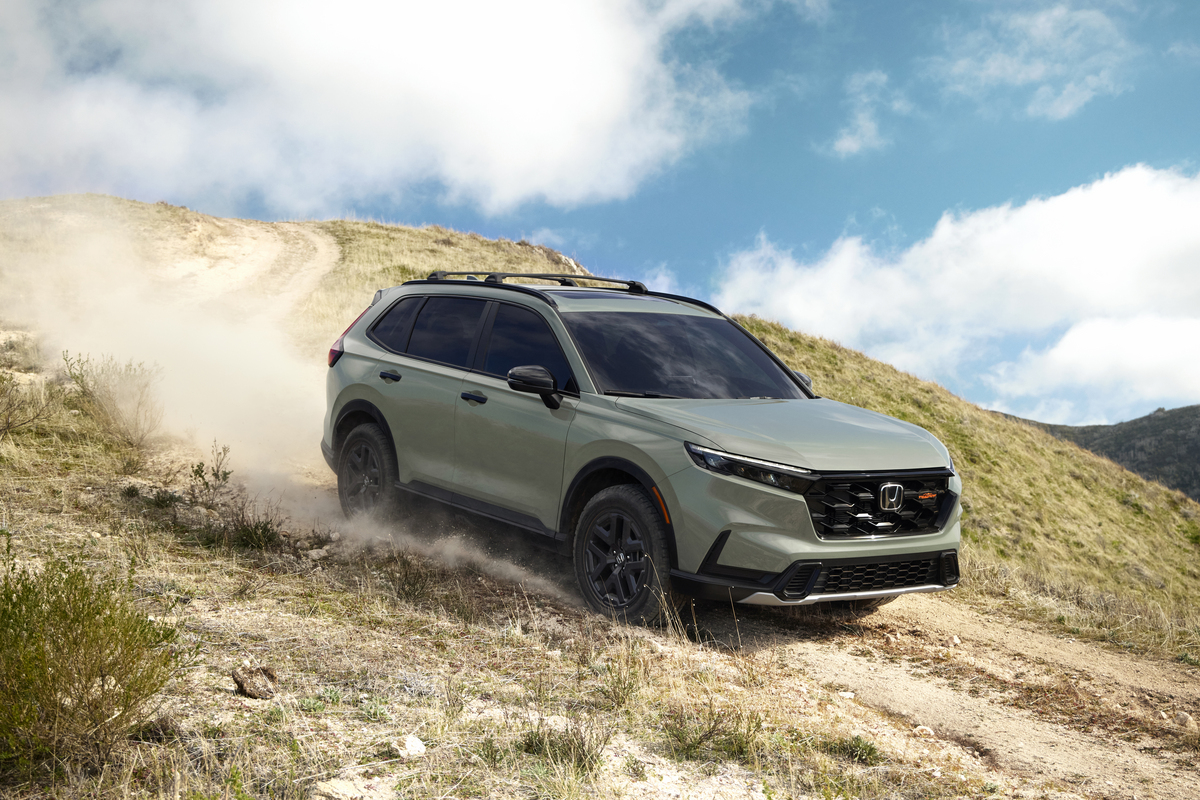
- Price
- $30,920 – $42,550
- Powertrain
- Hybrid
- Combined fuel economy
- 40 MPG
- Body type
- suv
.jpg)
honda cr-v main text
1. Quick Take
The 2026 Honda CR-V Sport Hybrid FWD is the "heart of the market" for compact crossovers. It utilizes a 2.0-liter engine with a two-motor hybrid system, favoring a simple "fill-up-and-go" approach over plug-in complexity. This FWD configuration targets urban centers and milder climates where maximum fuel efficiency outweighs the need for AWD. Analysts view it as the segment's "default choice" ; it isn’t an enthusiast's car, but rather a bridge between basic transport and near-premium comfort. The "Sport" trim adds aggressive blacked-out accents that contrast its pragmatic soul. What sets it apart is refinement; while rivals can feel like "appliances," the CR-V offers seamless integration and a sophisticated chassis. It is widely considered the most well-rounded option. However, it lacks the "wow" factor of high-tech Korean rivals and carries a price tag that might surprise value-oriented shoppers.
2. Its Main Competition
The CR-V Sport Hybrid competes in a "ruthless" segment. Primary rivals include the Toyota RAV4 Hybrid, Hyundai Tucson Hybrid, and Kia Sportage Hybrid , with secondary pressure from the Ford Escape Hybrid and Mazda CX-50. The RAV4 matchup is most significant, often framed as "refinement" (Honda) versus "utility" (Toyota). While the RAV4 is more rugged, the CR-V is quieter and smoother. Against the Korean duo, the difference is philosophical: they offer polarizing designs and high-tech features at lower prices. Honda is the "grown-up"—conservative, engineering-focused, and winning on resale value and driving fluidity. The Mazda CX-50 is the only rival that drives better, though it lacks the Honda's interior volume. Finally, while the Ford Escape matches it on paper for MPG, its interior feels cheaper than Honda's premium-adjacent quality.
3. Its Buyer’s Demographics
The demographic profile of this buyer is pragmatic, educated, and financially stable. These "smart spenders" often have the income for luxury vehicles—typically $75,000 to $100,000+—but prioritize reliability and safety over prestige. Two main life-stage cohorts dominate: young professional families (30s to 40s) needing their first "real" family hauler , and downsizing empty nesters (50s to 60s) moving out of larger SUVs. The latter appreciate the high "hip-point" for easy entry and exit. This FWD trim specifically appeals to urban commuters and those in non-snowbelt regions who view AWD as unnecessary weight. High education levels correlate with these "research-heavy" buyers who scrutinize residual values and safety ratings before visiting a dealership.
4. Design
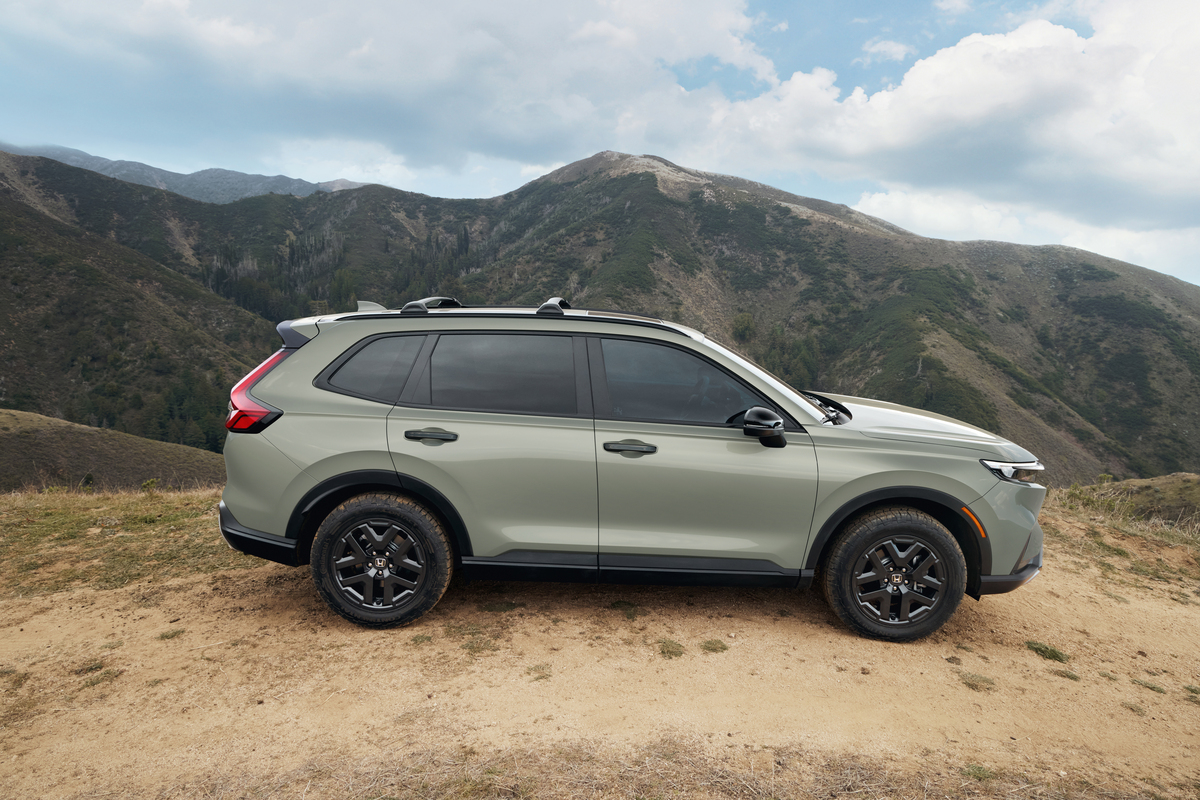
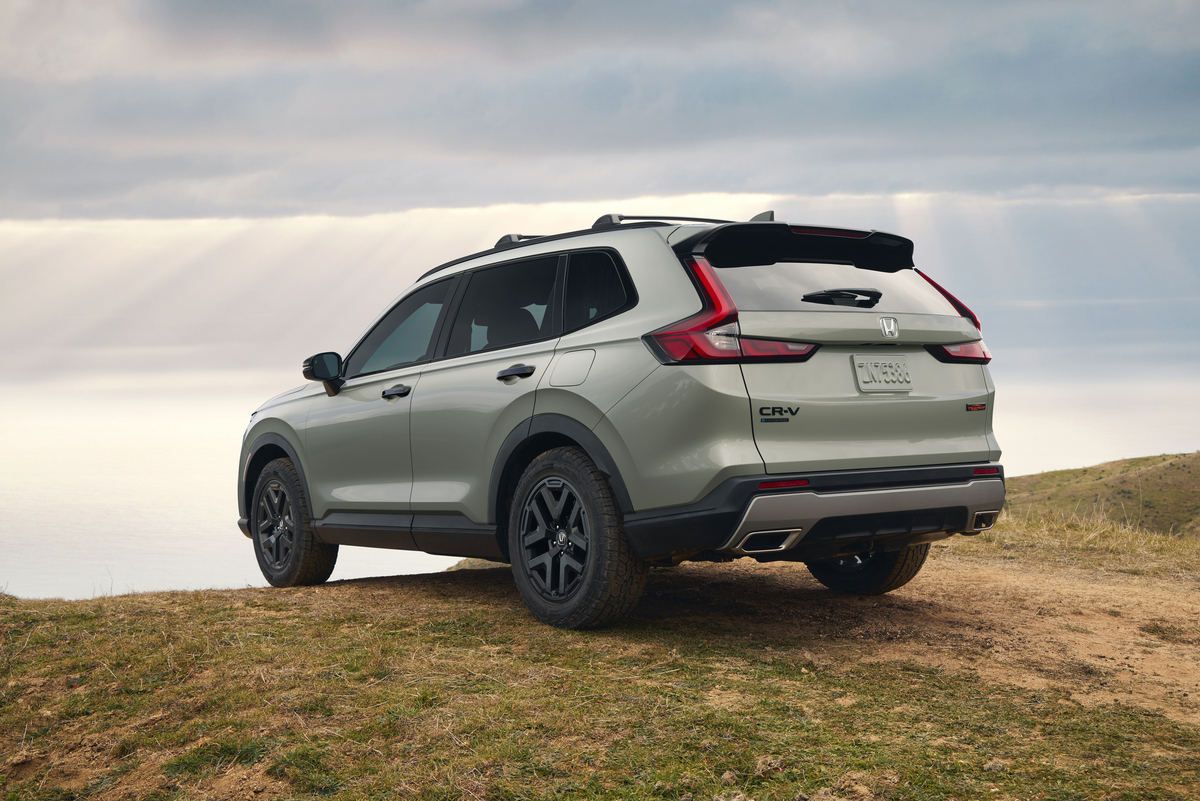
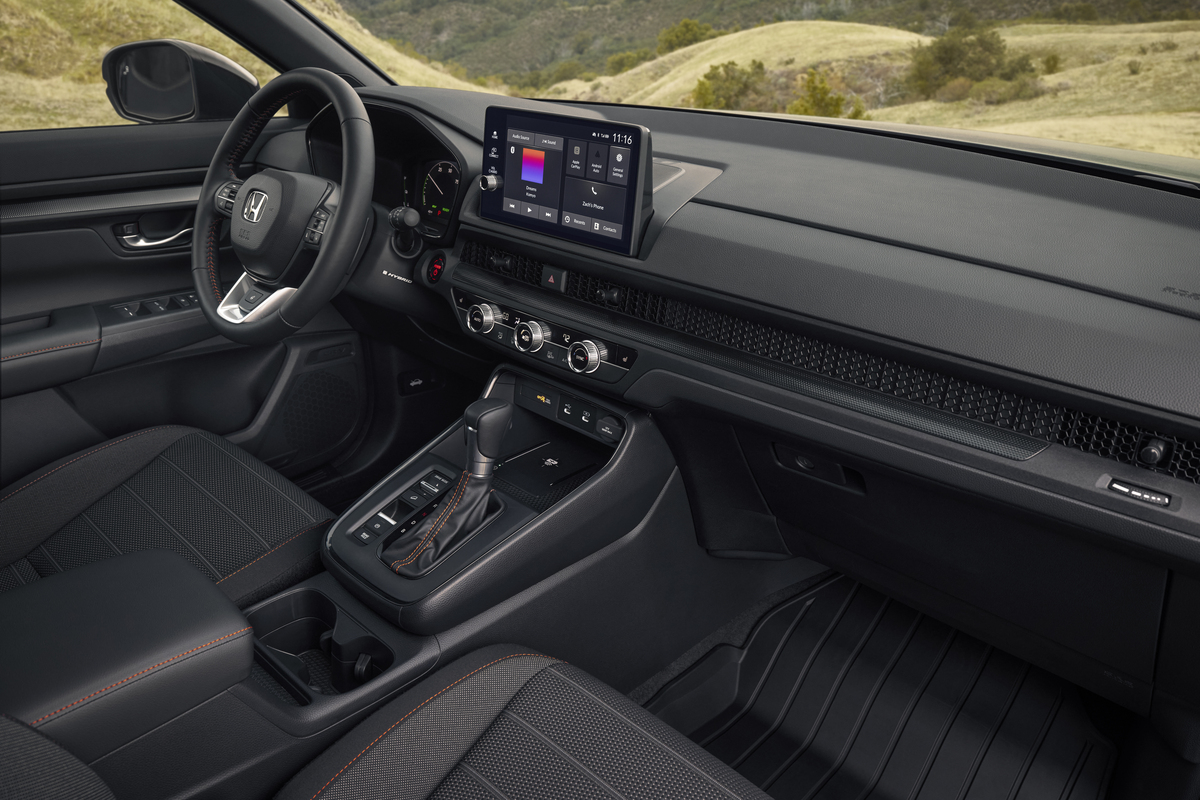
The design of the 2026 CR-V is mature and intentionally conservative. Honda has traded curvy, minivan-adjacent silhouettes for a squared-off, upright SUV stance. The "Sport" trim emphasizes this with blacked-out 18-inch wheels and dark grille accents. It avoids the polarizing "origami" creases of the Tucson or the "insect-like" fascia of the Sportage. Reviewers agree this "safe" styling ensures the vehicle won't look dated in five years. Inside, the "simplicity as luxury" approach is celebrated. A metal honeycomb mesh strip spans the dashboard, concealing vents and resisting fingerprints. The layout creates a sense of width and airiness. While it doesn't aim for ultra-luxe, it succeeds in feeling modern and durable. It strikes a "premium-adjacent" sweet spot between Spartan utility and over-styled competition.
5. Interior & Cargo Room
In interior packaging, the CR-V is the undisputed spatial leader of its class. The defining metric is the rear seat legroom, measuring over 41 inches. This means six-foot adults can sit comfortably behind six-foot drivers, and bulky child seats fit without crushing front passengers. Cargo capacity is equally impressive, offering 36 to 39 cubic feet behind the second row and over 76 cubic feet with seats folded. This effectively beats the Mazda CX-5 and Ford Escape. A standout feature is the rear door opening angle, which is nearly 90 degrees, facilitating easy loading of toddlers or heavy boxes. The only hybrid-specific downside is the battery packaging, which prevents a perfectly flat load floor in every configuration—a minor compromise for class-leading volume.
6. Ergonomics & Comfort
The CR-V’s ergonomics are summed up as "easy to live with". Honda is praised for retaining physical knobs and buttons for volume and climate, resisting the trend of burying functions in screens. This tactile approach makes the car intuitive with a minimal learning curve. Comfort is anchored by "Body Stabilizing Seats," which reduce fatigue on long hauls. However, the "Sport" trim lacks power height adjustment for the front passenger. Visibility is a major strength; by mounting mirrors on the doors and keeping the dashboard low, Honda provides a commanding view with minimal blind spots. Daily practicality is rounded out by a deep center console and door pockets that fit large water bottles.
7. Interior, Fit & Finish
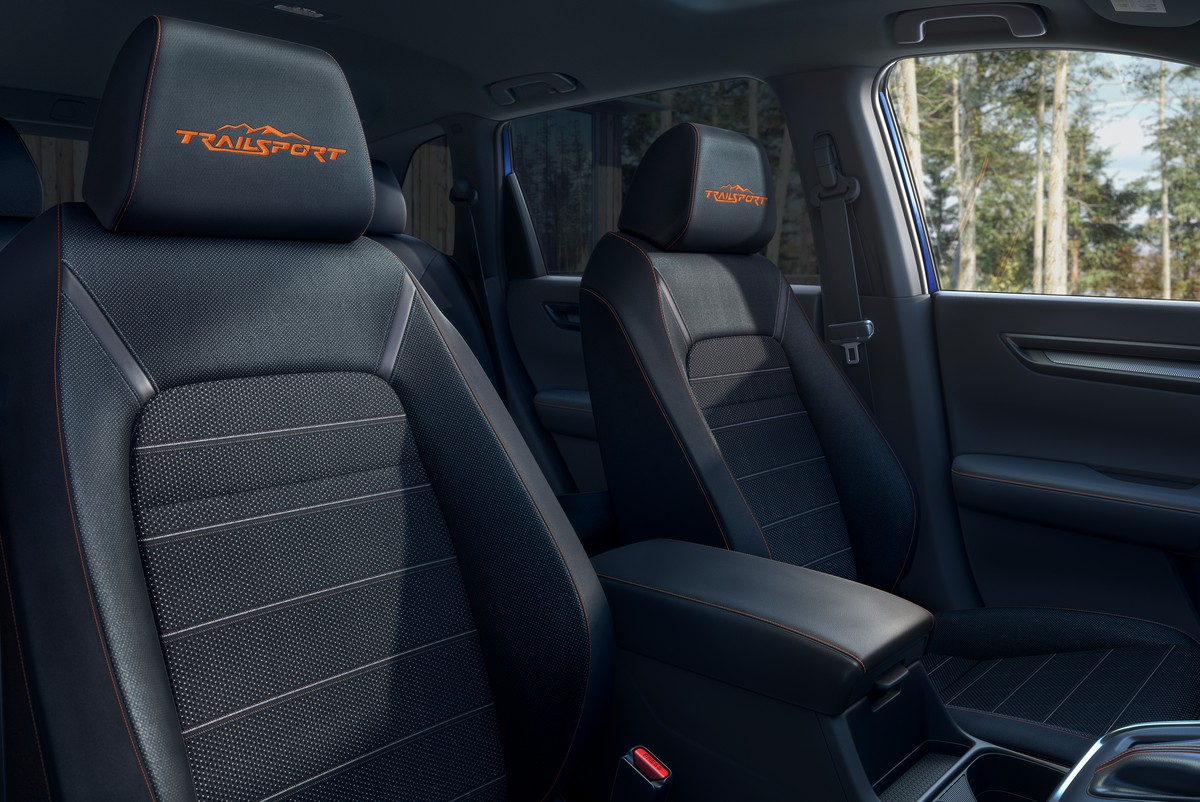
The cabin feels "well screwed together" and is a clear step up from previous generations. The honeycomb mesh dash elevates quality beyond typical economy plastics. Tactile switchgear, like the "clicky" climate knobs, is frequently compared to premium brands like Audi. While material quality is mixed, major touchpoints (steering wheel, armrests) use soft-touch materials. Harder, scratch-prone plastics are limited to areas below the beltline. The "Sport" trim features high-quality cloth upholstery with orange stitching; though less luxurious than leatherette, it is durable and grippy. Overall, fit and finish are highly rated, with tight panel gaps and an interior free of the rattles sometimes found in the Ford Escape.
8. Driver & Pass UX
The User Experience (UX) follows a "function over flash" mentality. The infotainment screen (7 or 9 inches) is responsive and stable, though it lacks the cinematic graphics of the Tucson. The menu structure is logically flat, so drivers don’t have to dig for basic settings. Smartphone integration via Apple CarPlay and Android Auto is standard, though wireless connections occasionally suffer from hiccups. A "grandma-proof" highlight is the inclusion of physical "Home" and "Back" keys, allowing users to escape confusing menus instantly. While voice control is merely average, the overall UX is designed to be "invisible"—it rarely frustrates, meeting the specific needs of its pragmatic demographic.
9. Sound System
The audio experience in the CR-V Sport Hybrid FWD is best described as "utilitarian". This trim features a standard 6- or 8-speaker system, as the premium Bose setup is reserved for the Sport Touring. The system is tuned for vocal clarity, making it excellent for podcasts and news. However, music lovers will find limitations: bass performance is often thin or muddy, and highs can become harsh at high volumes. Comparison tests usually place this audio behind the base offerings of the Mazda CX-5 or mid-trim Korean rivals. While adequate for average commuters, audiophiles should consider an aftermarket upgrade or stepping up to the Touring trim.
10. Acceleration
The CR-V Sport Hybrid isn't "fast," but it is arguably the most "drivable" in its class. The 204-horsepower system relies on 247 lb-ft of electric torque for instant, zippy response from stoplights. The 0-60 mph sprint takes roughly 7.5 to 8.0 seconds. This is quicker than the gas-only CR-V and competitive with the RAV4 Hybrid, though it trails turbocharged Korean rivals. The defining trait is smoothness; "Linear Shift Control" simulates gear shifts to avoid the "rubber band" engine moan of older CVTs. The only consistent negative is the engine sound under maximum load: merging or hill climbing triggers a coarse drone that briefly disrupts the cabin's refinement.
11. Braking
Braking in hybrids can be tricky due to the hand-off between regenerative and friction systems, but the CR-V offers the most natural pedal feel in the segment. Unlike the RAV4, which can feel "grabby" or "spongy," the Honda provides linear, firm progression. Stopping power is competent but average, with panic stops from 60 mph requiring 120-125 feet. This is competitive with the Escape and RAV4, though slightly behind the Subaru Forester. The real advantage is the confidence it inspires in stop-and-go traffic; drivers maintain smooth control without the head-bobbing jerkiness often found in other regenerative systems.
12. Handling
Despite the cosmetic "Sport" badge, the CR-V Hybrid delivers respectable dynamics and is considered the most "car-like" drive among its primary rivals. The steering is accurate and linear, offering better feedback than the numb feel of the Toyota. On the highway, it tracks straight with excellent stability. While body roll is present in corners, it remains well-controlled and "composed". In the city, it feels agile with a tight 37.3-foot turning circle. While it lacks the true athletic spirit of a Mazda CX-5, it strikes the perfect balance for a family car: stable and safe, yet responsive enough not to bore the driver.
13. Interior Noise
The acoustic profile is a tale of two driving states. At steady cruise or city speeds, the cabin is quiet and well-isolated. Electric operation is silent, and wind noise is managed better than in previous generations. However, hard acceleration breaks this tranquility. The e-CVT causes engine RPMs to hang high during merges, resulting in a coarse "moan" that is louder than in a turbocharged Tucson. To combat this, Honda uses Active Noise Cancellation (ANC) to pump anti-noise frequencies through the speakers. This effectively mitigates road boom and steady-state hums, but it can't fully mask the engine's complaints at full throttle.
14. Ride Quality
The CR-V Sport Hybrid ride is characterized as "composed" and "European". It lands on the firmer side, absorbing impacts with a single, controlled motion rather than floating like an old Buick. This makes the car feel planted and substantial. There is a specific advantage to the "Sport" trim: its 18-inch wheels have taller tire sidewalls than the 19-inch wheels on the Touring trim. This setup offers a more compliant ride over sharp potholes and broken pavement. Overall, the ride is excellent for its class, filtering out expansion joints and creating a relaxed environment for long travel. While the Toyota may be softer, the Honda strikes a superior balance of comfort and discipline.
15. Driver Assist Systems
Honda Sensing is standard and viewed as one of the most natural-feeling suites in the mainstream market. It includes Adaptive Cruise Control (ACC), Lane Keeping Assist, and Blind Spot Monitoring. The ACC is a standout, reacting smoothly and gradually when cars cut in, rather than slamming on the brakes. Lane Keeping Assist effectively centers the car without "ping-ponging" between lines, though it can be assertive on winding roads. Blind Spot Monitoring is essential due to the thick rear pillars. These systems are reliable with a low false-positive rate. While it lacks remote-parking gimmicks, it is considered top-tier for keeping a family safe on highway trips.
16. Mileage
Efficiency is the primary reason this vehicle exists, and it delivers. EPA estimates for the FWD model are 43 mpg city, 36 mpg highway, and 40 mpg combined. Real-world reports suggest these figures are highly achievable, especially in city traffic. However, highway efficiency drops more steeply than the Toyota RAV4 Hybrid's. The Honda’s system is less efficient at sustained speeds above 75 mph. Environmentally, it emits approximately 220-240 grams of CO2 per mile. While not zero-emission, it represents a massive reduction in carbon footprint compared to a standard gas SUV, effectively bridging the gap for buyers without charging access.
17. Safety
The CR-V Sport Hybrid is built like a fortress, consistently earning a Top Safety Pick+ from the IIHS and a 5-Star Overall Rating from the NHTSA. It excels in updated side-impact tests thanks to Honda’s "ACE" body structure designed to deflect crash energy. Uniquely, Honda includes the full suite of active safety tech as standard equipment even on this mid-range Sport trim. This contrasts with competitors who often hide the best safety features behind top-tier paywalls. The combination of excellent crash scores, standard accident-avoidance technology, and superior outward visibility makes this one of the safest vehicles for a family.
18. Pricing
The 2026 CR-V Sport Hybrid FWD is a semi-premium offering with an MSRP typically ranging from $35,500 to $36,500. This places it on the higher end of the mainstream spectrum. For context, a base RAV4 Hybrid costs less, and a similarly priced Tucson Hybrid offers far more luxury features. Honda essentially charges a "refinement tax". Buyers are paying for better driving dynamics, a spacious interior, and brand reliability. High demand also means the CR-V is less subject to dealership discounts than its rivals. While not the budget option, the price is justified by the product's polish for those not hunting for the lowest possible monthly payment.
19. Value
The "value" here is a paradox. If judged by "features per dollar," the CR-V scores poorly; a Hyundai Tucson at this price includes leather seats and a panoramic roof, while the Sport trim is relatively spartan. However, when judged by "Total Cost of Ownership," it is arguably the best in its class. It retains its resale value better than almost any competitor, neck-and-neck with the RAV4. It depreciates slowly, breaks rarely, and sips fuel. Consequently, it’s framed as a "Smart Buy". You pay more upfront for fewer gadgets, but you get more money back when you sell it five years later.
20. Reliability
Reliability is the cornerstone of the Honda brand, and this hybrid largely upholds that reputation. The 2.0-liter hybrid powertrain is robust; many experts rate it as more reliable than the gas-only 1.5-liter engine. Because it lacks a traditional transmission, a common failure point is removed. It isn't flawless, however; some complaints exist regarding a "sticky" steering rack at highway speeds, though Honda has addressed this in updates. Minor infotainment glitches also occur. Compared to the field, it sits near the top, beating Ford and Korean rivals in predicted metrics and trailing only the Toyota RAV4 Hybrid. For the risk-averse, it is one of the safest places to park your money.
Frequently asked questions about the 2026 Honda CR-V Sport Hybrid FWD
Is the 2026 Honda CR-V Sport Hybrid FWD worth buying?
The 2026 Honda CR-V Sport Hybrid FWD is the "heart of the market" for compact crossovers. It utilizes a 2.0-liter engine with a two-motor hybrid system, favoring a simple "fill-up-and-go" approach over plug-in complexity. This FWD configuration targets urban centers and milder climates where maximum fuel efficiency outweighs the need for AWD. Analysts view it as the segment's "default choice" ; it isn’t an enthusiast's car, but rather a bridge between basic transport and near-premium comfort. The "Sport" trim adds aggressive blacked-out accents that contrast its pragmatic soul. What sets it ap
How much does the 2026 Honda CR-V Sport Hybrid FWD cost?
The 2026 Honda CR-V Sport Hybrid FWD is priced at $30,920 – $42,550 , before destination, options, and incentives.
What is the fuel economy of the 2026 Honda CR-V Sport Hybrid FWD?
The 2026 Honda CR-V Sport Hybrid FWD returns 40 MPG combined per published EPA figures.
How this review is produced
moblr meta-reviews are generated by aggregating multiple published expert road tests using AI consensus and sentiment analysis, then read and reviewed by a human editor before publication. Category ratings on the −50 to +50 scale show how each vehicle compares to the average for its segment. Learn more about the moblr review process.